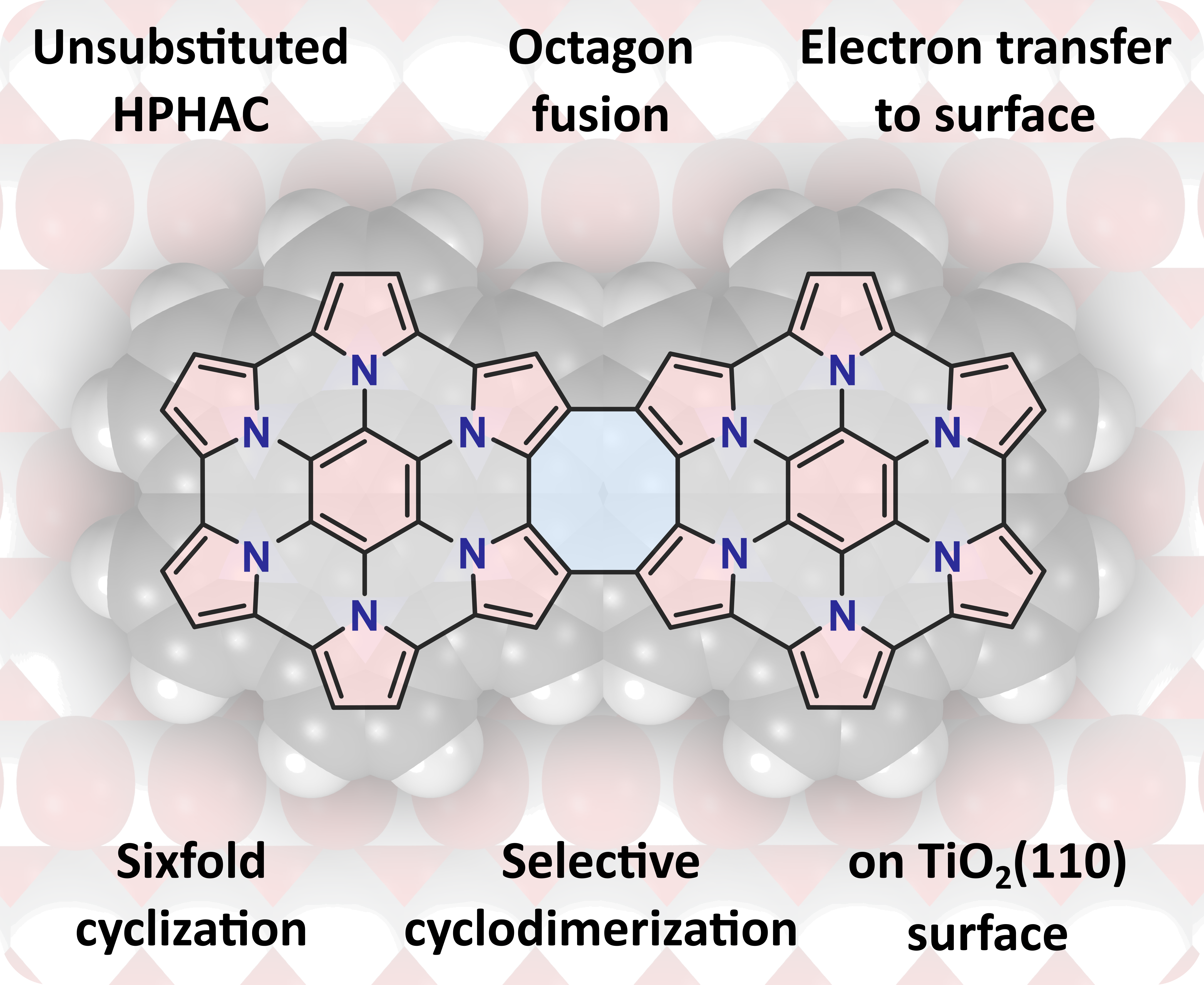
Surface-assisted reactions on nonmetallic substrates remain much less developed than their counterparts on metals, especially for heteroatom-doped precursors and intermolecular coupling processes. Here we show that TiO2(110) can support not only cyclodehydrogenation of a nitrogen-rich nanographene precursor but also annulative intermolecular coupling on a semiconducting oxide surface. Under ultrahigh vacuum, hexapyrrolylbenzene (HPB) undergoes cyclodehydrogenation on rutile TiO2(110) to give unsubstituted hexapyrrolohexaazacoronene (HPHAC, 1). Upon further annealing, 1 undergoes dehydrogenative dimerization to form a cyclooctatetraene-annulated HPHAC dimer (2), as supported by scanning tunneling microscopy and spectroscopy (STM/STS), density functional theory (DFT), and simulated STM images. The dimer, but not the monomer, undergoes single-electron transfer to the substrate to form [2]•+, consistent with STM/STS observations, its lower ionization threshold, and computed frontier orbital energies. Gas-phase calculations are consistent with a plausible arenium-type pathway for annulative dimer formation and further indicate that oxidation increases global aromatic character across the fused framework.